
Triggers Worksheet: Free Printable PDF
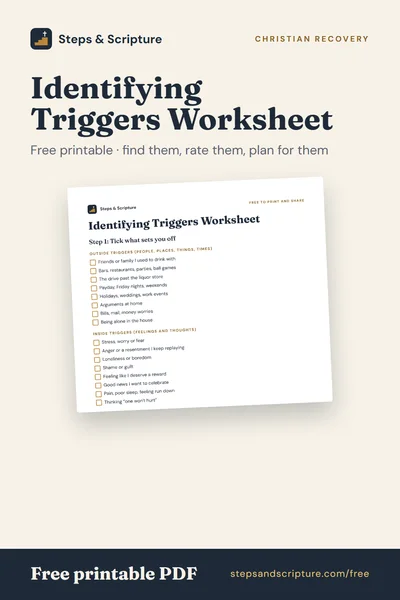
This triggers worksheet helps you identify the people, places, feelings and times that make you want to drink, rate how risky each one is, and write down what you'll do instead. It's free to print, with no sign-up.
Some triggers are outside you, like a bar on the way home. Some are inside, like loneliness at 9 pm. You can't avoid all of them, but you can see them coming and have a plan ready. Fill it in with your sponsor or someone you trust.
Download free PDFFree. No email, no sign-up. A printable PDF, letter size.
Step 1: Tick what sets you off
Outside triggers (people, places, things, times)
- Friends or family I used to drink with
- Bars, restaurants, parties, ball games
- The drive past the liquor store
- Payday, Friday nights, weekends
- Holidays, weddings, work events
- Arguments at home
- Bills, mail, money worries
- Being alone in the house
Inside triggers (feelings and thoughts)
- Stress, worry or fear
- Anger or a resentment I keep replaying
- Loneliness or boredom
- Shame or guilt
- Feeling like I deserve a reward
- Good news I want to celebrate
- Pain, poor sleep, feeling run down
- Thinking “one won't hurt”
Step 2: The HALT check
Many urges are a body or a heart asking for something else. Before you act on one, ask: am I Hungry, Angry, Lonely or Tired?
- Hungry: eat a real meal or a snack. Drink water.
- Angry: pray for the person, then tell your sponsor about it before you do anything.
- Lonely: call someone, go to a meeting, sit with people.
- Tired: rest. Go to bed early. Things look different in the morning.
Step 3: Rate them and make a plan
Write your triggers below. Rate each from 1 (a little pull) to 5 (I'm in danger). Then write what you'll do instead. Be specific: a name, a meeting, a place to go.
| Trigger | Outside or inside | Risk 1–5 | What I tell myself | What I'll do instead |
|---|---|---|---|---|
| Payday Friday | Outside | 5 | “I worked hard, I earned it.” | Pay bills first. 6 pm meeting. Call Dave on the way. |
The first row is an example. The PDF has 9 blank rows to fill in.
An example
Sam noticed he wanted a drink most on Sunday nights. Sitting with it, he saw the real trigger wasn't Sunday. It was dread about Monday at work, plus being alone after his kids went back to their mom's. So his plan changed: an online meeting at 8 pm on Sundays, a call to his sponsor before bed, and a few verses he reads when the dread comes. The urge still shows up. Now it finds him busy.
Step 4: My top three
- My riskiest trigger, and exactly what I'll do when it comes:
- My second riskiest trigger, and my plan:
- My third riskiest trigger, and my plan:
- Which of the four (hungry, angry, lonely, tired) hits me hardest, and when?
- Which triggers can I avoid for now, and which do I need to face with help?
How to use it
- Tick every trigger that fits, even the ones that seem small.
- Do the HALT check and notice which of the four shows up most.
- Fill in the table, rate each trigger, and write a real plan for it.
- Go over it with your sponsor or someone in recovery.
- Copy your top three into your relapse prevention plan and keep it where you'll see it.
Safety first. If you drink heavily every day, stopping suddenly can be dangerous. Talk to a doctor before you quit.
Scripture to go with it
“No temptation has overtaken you that is not common to man. God is faithful, and he will not let you be tempted beyond your ability, but with the temptation he will also provide the way of escape, that you may be able to endure it.”
“Watch and pray that you may not enter into temptation. The spirit indeed is willing, but the flesh is weak.””
“Search me, O God, and know my heart! Try me and know my thoughts! And see if there be any grievous way in me, and lead me in the way everlasting!”
Written by Steps & Scripture. Steps & Scripture is not affiliated with Alcoholics Anonymous World Services, Inc. This worksheet is not medical care; talk to a doctor about withdrawal.

Talk it through with Jimmy or Sarah — first month free
Jimmy and Sarah are AI sponsors who know the Twelve Steps and the Bible. They'll listen, walk the steps with you, and keep pointing you to real people: a meeting, a sponsor, a church.
Free to download · first month free, no card · adults 18+
After the first month, talking with Jimmy or Sarah needs Plus ($9.99/month or $59.99/year).
Common questions
What's the difference between an outside and an inside trigger?
Outside triggers are people, places, things and times, like a party or payday. Inside triggers are feelings and thoughts, like anger, loneliness or “I deserve one.” Most urges come from both at once.
What does HALT stand for?
Hungry, Angry, Lonely, Tired. It's a quick check people in recovery use. When the urge hits, fix the one you're feeling first, and the urge often gets smaller.
Should I avoid every trigger?
Early on, avoid what you can: you don't need to be at the bar. Some triggers, like stress or family, can't be avoided. For those, plan ahead and don't face them alone.
Can I use this worksheet with a group?
Yes. Print as many as you like and share them freely.
Get the daily reading by email
One short reading a day: a verse, a few honest words, one thing to do and a prayer. Unsubscribe any time.
We'll send one email to confirm. We never share your address.